You are buying a deliverable, not a product
A sign is a manufactured assembly with a drawing, a bill of materials, a test record, a packing list and an installation document. A trader can quote the same product and deliver only the box: the drawing is inconsistent, the modules come from whichever bin was open, the crate has no site label, and the missing transformer is discovered on the morning of the install.
The questions that expose that difference are boring ones. Who approves the shop drawing, and what happens when I mark a change? Will I see a photograph of my letters lit before they are packed? What is in the crate besides the letters? If a module fails in year two, which bin do you pull the replacement from?
A manufacturer answers these with process. A trader answers them with reassurance.
What a factory visit should show
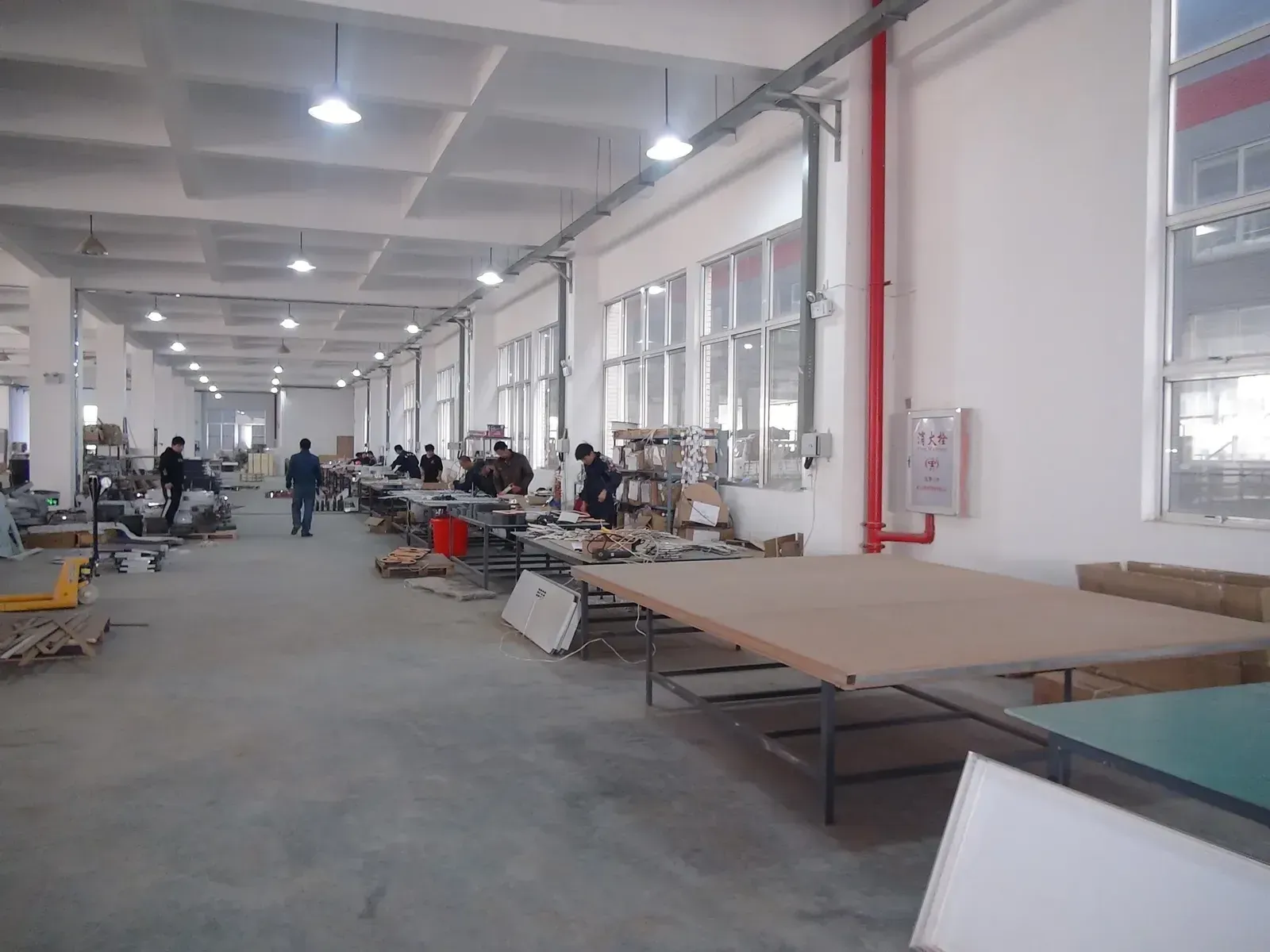
Anyone can photograph a clean showroom. The production floor tells the story, and a useful visit takes about an hour.
Look for material stock in the grades you were quoted - acrylic sheet, aluminium coil, stainless, LED modules in labelled bins - because a factory that buys per job cannot hold a bin for your repeat order. Look at the welding and the paint area: a letter's quality is decided there, not at the trim cap. Ask to see an aging test or an illumination test running, and the station where each letter is photographed before packing.
Then look at the packing area. Crates, foam, labels and a packing list on the wall tell you more about shipping damage rates than any promise. If there is no dedicated packing area and no records of what went where, every rollout will be an improvisation.
Finally, ask for the spare parts shelf. A factory that services what it sells keeps modules and faces; one that only ships new product does not.
The golden sample is the cheapest insurance you will buy
Colour, depth, finish and glow are hard to describe and easy to argue about later. A golden sample settles it once: a single letter or a small panel, built to the final specification, approved physically by the client and kept by both sides as the reference for every subsequent unit.
What makes a sample useful: it is built on the production line, not in a design studio; it uses the actual paint and the actual LED bin; it is lit at the actual output; and it is photographed under the lighting of the intended site, or at least under neutral light with the site photo beside it.
What makes a sample useless: a rendering, a colour chip alone, or a sample built with materials that will not be used in production. Those create an approval that cannot be met.
For a multi-store programme the golden sample should be kept by both parties with the approved date and revision marked, because it is the only artefact that survives staff changes on either side.
Certifications: what actually matters
Signs are electrical products in most markets, and the certification that matters is at component level: a UL or ETL listed power supply and listed LED modules, with the listing numbers on the components themselves. A logo on a brochure is not a listing.
Beyond that, three things travel with a sign across borders. An IP rating that is declared and actually met at the joints - IP65 for an outdoor box is a construction claim, not a sticker. RoHS and REACH compliance for materials sold into the EU, which is a documentation question as much as a materials one. And a fire rating for acrylic faces where the local code requires it, usually a class B or equivalent declaration from the sheet supplier.
Ask for the documents, not the claims. A supplier who has them sends them within a day; one who does not will describe them at length.
The communication rhythm that prevents surprises
Most disputes in sign manufacturing are timing disputes wearing a technical costume: the drawing was approved late, the change came after cutting, the crate shipped before the site was ready.
A workable rhythm has four fixed points. Drawing approval, with a revision number and a signature. A pre-production confirmation of materials and colours, ideally with a photograph of the sheet and the bin. A pre-packing photo set, showing the letters lit, the crate contents and the packing list. And a shipping notice with the tracking and the packing list attached.
Each of those is a chance to catch a problem while it is still cheap. A manufacturer who resists them is telling you that their process does not have those checkpoints, and that the first time you will see your sign is when it arrives.
After-sales is a parts strategy
Every sign will eventually need a module, a face or a driver. The question is whether the replacement matches what is on the wall.
Three commitments make after-sales real. Module matching: replacements come from the same bin, or the same batch if the programme is still running, so a repaired letter does not read slightly warmer than its neighbours. A spares allowance agreed at order: typically one face or one module set per ten signs, delivered with the main shipment. And records: an as-built drawing and photo per site, so a fault can be identified by letter number rather than by description over the phone.
Where a brand runs multiple markets, the spare parts question also decides who can service the sign locally. A local installer can replace a module if the module is in the store's own crate; they cannot if the part has to be shipped from the factory each time.
Three references worth more than a case study
Reference lists are curated. Three phone calls are not, and each answers a different question.
The first is a client who had a problem. Ask how the factory responded: was there a person who owned it, how long the replacement took, and did it come from the same bin. Every supplier has failures; the useful signal is the recovery.
The second is a client who reordered. A repeat order after a rollout is the clearest evidence that the drawing, the packing and the communication survived contact with a real project.
The third is an installer, not a client. Installers see the mistakes that never reach the buyer's inbox - templates that do not match, anchors that do not suit the wall, wiring diagrams that skip the driver. Ask what arrived wrong and how often.
If a supplier cannot give you one name in each category, that is itself the answer.
One document answers more of those questions than any reference call: ask for the released shop drawing from a live project. What it should contain, and what to check before approving it, is set out in sign fabrication drawings.